SD Card
In this page, we connect an SD card to the Pico board by using shell commands.
SD Card Reader Modules
SD card reader modules are basically just an SD card slot with some resistors and a voltage regulator, but the supply voltage, signal level, and presence of pull-up resistors vary by module, so be careful.
Below are some SD card reader modules I had on hand (mainly from Amazon), with notes on supply voltage, pull-up resistors, and signal levels.
| Appearance | Notes |
|---|---|
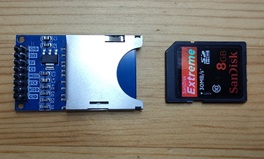 |
Standard SD card module. Both 5V and 3.3V supply pins are available. If using 5V, a voltage regulator steps down to 3.3V for the SD card. All signal lines have 10kΩ pull-up resistors, so no external pull-ups are needed. Signal level is 3.3V. |
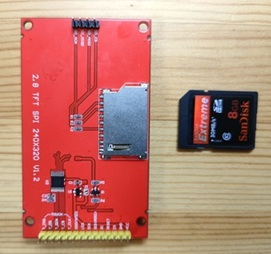 |
Standard SD card slot on the TFT LCD ILI9341. Power is supplied from the TFT LCD connector at 3.3V. External pull-up resistors are required1. Signal level is 3.3V. |
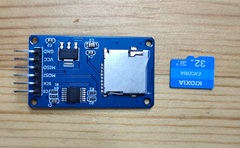 |
microSD card module. Supply voltage is 5V, stepped down to 3.3V by a voltage regulator. No external pull-ups are needed. Signal lines have a buffer (74HC125), so it can connect to both 3.3V and 5V signal levels. |
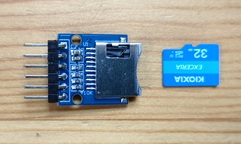 |
microSD card module. Supply voltage is 3.3V. All signal lines have 10kΩ pull-up resistors, so no external pull-ups are needed. Signal level is 3.3V. |
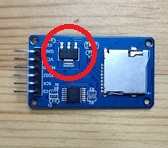
To distinguish the supply voltage, if the SD card reader module has a voltage regulator like the one shown below, use 5V supply; if not, use 3.3V supply.
-
In my tests, the SD card worked without pull-up resistors, but some SD cards may require them. If it doesn't work, check for pull-up resistors. ↩