Hysteresis
Hysteresis
Hysteresis helps filter slow or noisy signals. The default is on, but you can set it to off with the hyst subcommand. Disabling hysteresis may make the input unstable for slowly changing signals.
Experiment circuit:
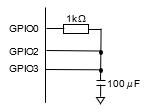
The time constant is \(CR=1000 \cdot 100 \cdot 10^{-6}\) = 100ms. Generate a 1000ms high pulse on GPIO0 and observe with GPIO2 and GPIO3.
First, enable hysteresis on both pins and run (use pio1 for Pico):
L:/>gpio 2,3 func:pio2 pull::none
L:/>gpio 2 hyst:on
L:/>gpio 3 hyst:on
L:/>la enable --samplers:4 -p 0,*,2,3
L:/>gpio 0 func:sio dir:out put:0 sleep:1000 put:1 sleep:1000 put:0
L:/>la print --reso:300000
Result:
 Time [usec] P0      P2  P3
             │       │   │
        0.00 └─┐     │   │
   134383.46   │     └─┐ │
   134556.04   │       │ └─┐
               │       │   │
               │       │   │
   999803.38 ┌─┘       │   │
  1279721.92 │         │ ┌─┘
  1282086.20 │       ┌─┘ │
 Time [usec] P0      P2  P3
Next, disable hysteresis on GPIO3:
L:/>gpio 2,3 func:pio2 pull::none
L:/>gpio 2 hyst:on
L:/>gpio 3 hyst:off
L:/>la enable --samplers:4 -p 0,*,2,3
L:/>gpio 0 func:sio dir:out put:0 sleep:1000 put:1 sleep:1000 put:0
L:/>la print --reso:300000
Result: